






Copyright © borneowildlife.org. All rights reserved. Web designed & hosted by suria.biz
FACTS OF PROBOSCIS MONKEY (长鼻猴)


PROBOSCIS MONKEY (Nasalis larvatus)






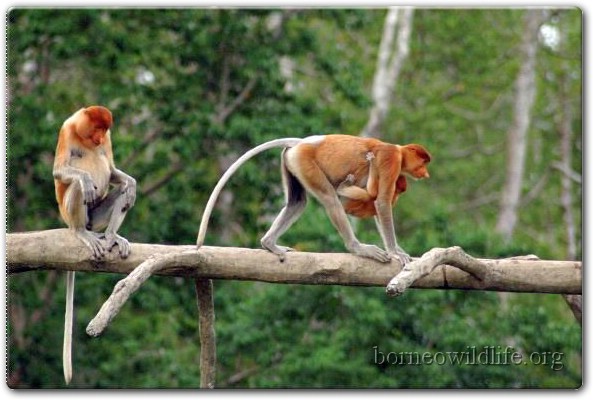
The Proboscis monkey has one of the most unusual appearances of any of the leaf-eating monkeys of the family Cercopithecidae. Both the Latin and common names of this species refer to the mature males' large pendulous nose that hangs down over their mouth. Local people referred to these large monkeys with their potbellies and red noses as 'Dutch monkeys' as they were considered such a caricature of the Dutch sailors and plantation owners of the area. Apart from their large noses, male Proboscis monkeys are also distinctive by being much larger and heavier than females, and having a bright red, visible penis and black scrotum. The coat is a light brown with red on both the crown of the head and the shoulders; the limbs and tail are grey in colour and there are cream patches on the throat. Infants are born with black fur and a vivid blue face. The cause of the males' large nose is still a matter of contention but may be a form of sexual selection, with females preferring males with large noses possibly as these enhance their vocalizations.
Proboscis monkeys are found in either coastal mangrove forests or in lowland rainforest close to freshwater rivers. Groups consist of single mature males and around 6 (wives) females and their young; adolescent males form bachelor groups until they can take over their own harem. Groups join together in larger more fluid troops to rest at dusk; these encounters may be noisy with rival males displaying to each other and often crashing through the branches. Unusually, females may switch harems several times in their lives, and they compete between each other to mate with the male of their group. When a female is ready to mate she will perform a head shaking and presenting display. A single offspring is born after a gestation period of nearly 6 months, remaining with their mother for the first few years; males will then leave to join bachelor groups. Young leaves make up the majority of the proboscis monkey diet between June and December, and fruit from January to May, although seeds and flowers are also consumed. These monkeys are excellent swimmers and have partially webbed feet; they can be seen readily leaping into the water with dramatic belly flop in order to cross rainforest rivers.
Numbers of Proboscis monkeys in Borneo have fallen dramatically in the last 40 years primarily as a result of habitat loss. Vast areas of the native rainforest have been cleared for timber and for the construction of oil-palm plantations, which now constitute one of Malaysia's top exports. Proboscis monkeys do not adapt to degraded habitat and recent technical advances have meant that even mangrove swamps may now be logged. Hunting is also a threat to the survival of this species; their propensity to gather in large groups on the river's edge makes these monkeys easy targets.
你知道吗?
長鼻猴是以树叶为主食的猴类,他们有着不寻常的外表。长鼻猴的拉丁名称和普通名称都是来自于雄性鼻子的长相,雄性的鼻子会随年龄而加长,甚至会垂下蓋住嘴巴。雄性長鼻猴除了他們的大鼻子与雌性有明显的不同外,体型也比雌性长鼻猴大些。成年公猴鼻子会随着年紀而增长,最后变成红色的大鼻子。長鼻猴的外观, 背毛为棕色,头部毛发两边和肩膀为褐色,四肢和尾巴都是灰色而在喉部则是米白色。刚出生的長鼻猴幼仔,全身的毛均为黑色,仔猴的顏部为蓝色。公猴大鼻子的原因仍是爭论的问題,其用途并不是很清楚,有可能是性选择的一种形式,母猴的择偶条件,是选择大鼻子的公猴。
長鼻猴是在沿海红树林或低地雨林接近淡水河流的地方被发现。长鼻猴过着群体生活(严格的群体制度),而一个典型的社会群体都是由一个成年的公猴及大约六只母猴和他们的幼猴所组成。但长鼻猴的社会群体比其他动物的群体,变化的速度要快得多。每过一段时间,群体中的首领就会驱逐尚未成年,但已能独立生活的年轻公猴离开。而这些被驱逐的年轻公猴就会集合一起,形成一个新群体 - “纯雄性群体”,以未成年但年龄较大的为首。但这些“纯雄性群体”是个极不稳定的群体,只要群体内的公猴成熟了,就会向其他“典型/正常”群体的首领挑战,如果战胜了,就会取代并接管这一社群的母猴及其他成员。但,这也会发生另一种奇怪的现象:有些母猴会带着哺育中德幼猴离开他原有的群体,而加入“纯雄性群体”里,过了几周再转到其他群体(据说是为了不被新首领杀害幼猴而不断的搬迁)。大部份长鼻猴在六月和十二月间都吃嫩叶维生,而一月至五月都吃果实,种子及花朵维生。這些猴子有着部分蹼足,这使他們能够轻易在河流中穿越熱帶雨林。
在过去的40年里,长鼻猴在婆罗洲的数量已经大幅下降,主要原因是他们的栖息地已丧失。原本的热带雨林已被大批采伐以取得木材及种植油棕榈园,现在已变成马来西亚顶级的产品出口国家之一。虽然部份的红树林已被保留,但由于栖息地的退化以及时代科技的进步,长鼻猴已经不能适应那样的生活环境。狩猎也对他们的生存构成了威胁,他们习惯在河水边聚集,因此容易变成狩猎者的目标。